
SUSTAINABILITY IN ACTION AT PIPIT RESTAURANT
Pipit Restaurant considers sustainability in our decision making.
Sustainability is complex! and the Australian restaurant industry lacks easy guides or policy on it. Pipit supports more collaborative learning by openly sharing our actions and policy in detail - not as definitive answers, but to encourage more open industry conversations.
Our framework focuses on produce as our core dining business
POLICY CONTACT:
Yen Trinh, Business Manager - admin@pipitrestaurant.com
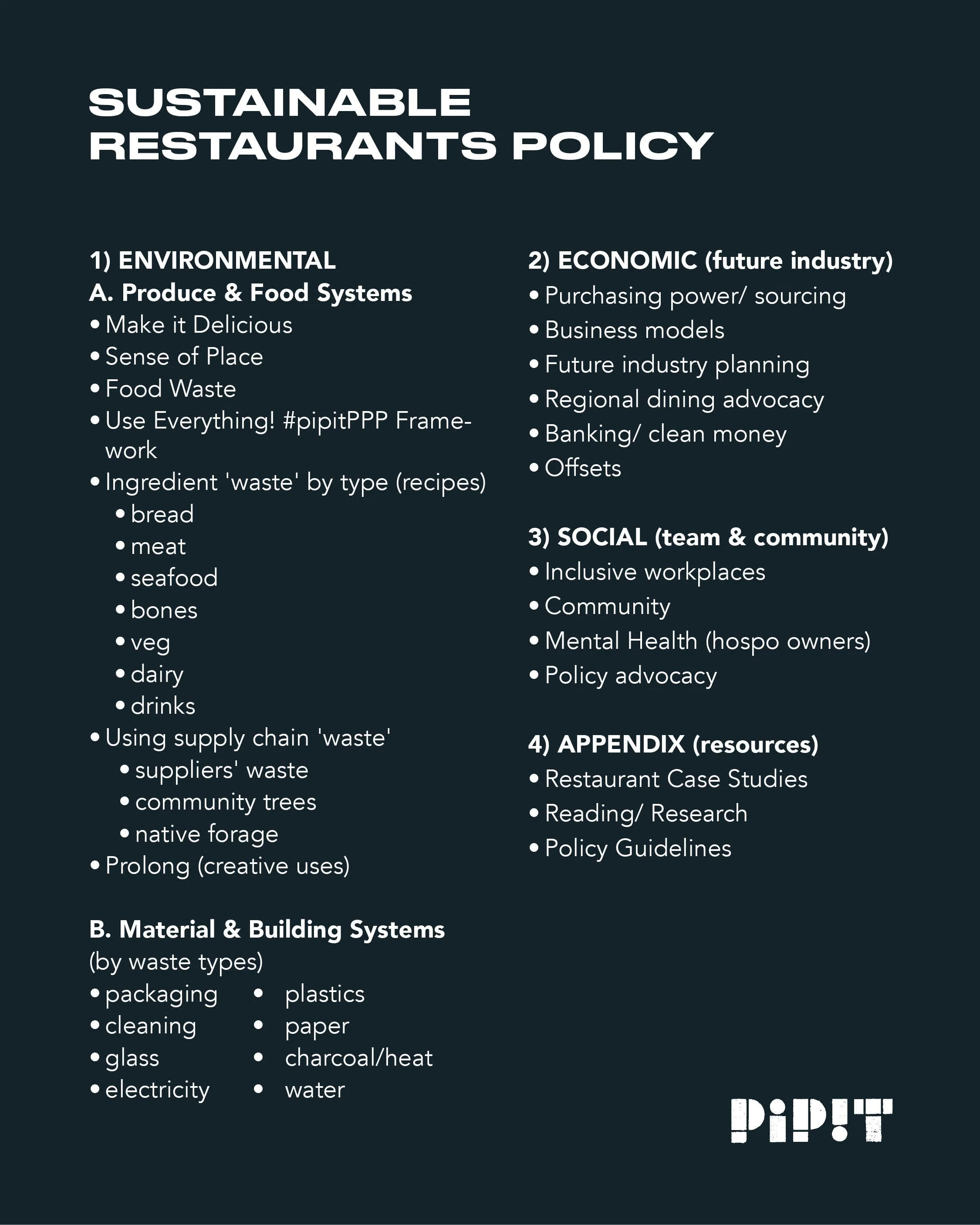
CONTENTS: POLICY SUMMARY
PART 1) ENVIRONMENTAL SUSTAINABILTY
i. PRODUCE & FOOD SYSTEMS
Ethos: Place & Flavour
PLACE: SEASONS & SENSE OF LANDSCAPE
“….a meal at Pipit is one of newness, creativity and thoughtfulness. The food at Pipit actually tastes like the landscape around it — that is to say: beautiful, subtropical, with a saline hint of the ocean and dunes” New York Times review (2021)
Our place, landscape, seasons. climate and environment fundamentally shapes our menu and restaurant.
Being connected to seasonal changes makes us more mindful to care, value and consider our environment more. eg, observing changes in late fruit seasons are related to environmental change.
We documented our place seasons and landscapes in the PIpit Book (2020).
We apply “what grows together goes together” is our flavour approach to explore the best in our area. We serve ingredients when they are best in season or preserved
FLAVOUR: MAKE IT DELICIOUS
Media Question : How do you get people to care about sustainability in cooking and eating? :
Pipit focuses on taste and creativity, first and foremost. Better sustainable produce just taste better. "Better" can be organic, local, picked closer to ripeness, uniquely native, delivered fresher etc. In our dining room, we also strongly share the stories of our produce and farmers. Every Pipit diner gets a map of our local producers at the end of the meal and we encourage locals and visitors to buy direct or visit them. Fostering that direct connection is how we hope more people start to care
FLAVOUR : REFRAMING VALUE & WASTE
Our creativity is best found in how we actively maximise our ingredients. Everything aims to be tasty and smart in minimising waste. As example this is seen in:
Efficient wood-fired cooking
Whole animal approaches and cured meats
Unique ferments & preserves
House made cheeses
This is grounded in a “ FROM SCRATCH” ethos. There is a lot venues can wholesale but we make everything in-house from bread, misos, hams, pastas to ice-creams. This is driven by technique and always wanting to learn - but it fundamentally makes things more delicious! We aim for bolder and more uniques flavours / produce that can’t be found elsewhere or “off the shelf”
Food waste is a key area that restaurants can innovate and inspire diners.
Traditional practices may leave up to 50% of an animal or fish unused when focusing only on primary cuts. Our "use everything" principles aim for over 90% recovery, though creative cooking techniques
Our mindset is more about "maximising ingredients" than "minimising waste".
We aim to add value and elevate all our produce (and it’s “waste”)
Costs and economic sustainability is part of this. Seafood/meats are accepted as “expensive” or “luxury” on plates, but some vegetables can be similar price per kilo. Throwing away offcuts is throwing away dollars (and potential flavour)
Ben’s lessons from Noma. “It first came from a creativity and flavour stance, but "sustainability" happened to cover much the same mindset. Noma taught me to look at suppliers, products and their by-products differently. It was always about "how do you use the whole thing?" Whether it's whole fish or whole tomato, the principle is the same. This time taught me to find or create luxury in everyday ingredients, and a mindset to treat all ingredients (and resources) as precious and valuable.”
Whole animal use helps reduce supply chain waste. UN Reports “35-50% harvested fish and seafood is either lost or wasted along the supply chain”. Recipe examples with FISH FRAMES
Sustainable Meats
We focus on seafood to reflect out coastal sense of place, and seek to source all meats responsibly. This means:
SEAFOOD
Since 2019, Pipit was one of the 1st chef ambassadors for the Good Fish Project. This AMCF Guide informs how we buy sustainable seafood (both aquaculture and wild caught).
We extend advocacy for seafood through creative projects like Gyotaku Art Prints and fish bone ceramics. Learn more > HERE
We support seafood labelling policy
POULTRY & GAME
We only use free-range poultry
We use wild game (eg kangaroo, venison) where it helps pest management
We choose not to serve farmed red meats (eg pork, beef, lamb) due to global land practices and it does not suit our lighter coastal menus. We acknowledge there are positive regenerative practises and innovations like SeaForest for cows.
WHOLE ANIMAL COOKING
We buy whole animals to creatively all parts and reduce supply chain waste.
In-house fermented seafood garums and cured meats (duck and seafood) are key unique products we make to boost flavour (and use offcuts)
Example - see duck salumi class > HERE
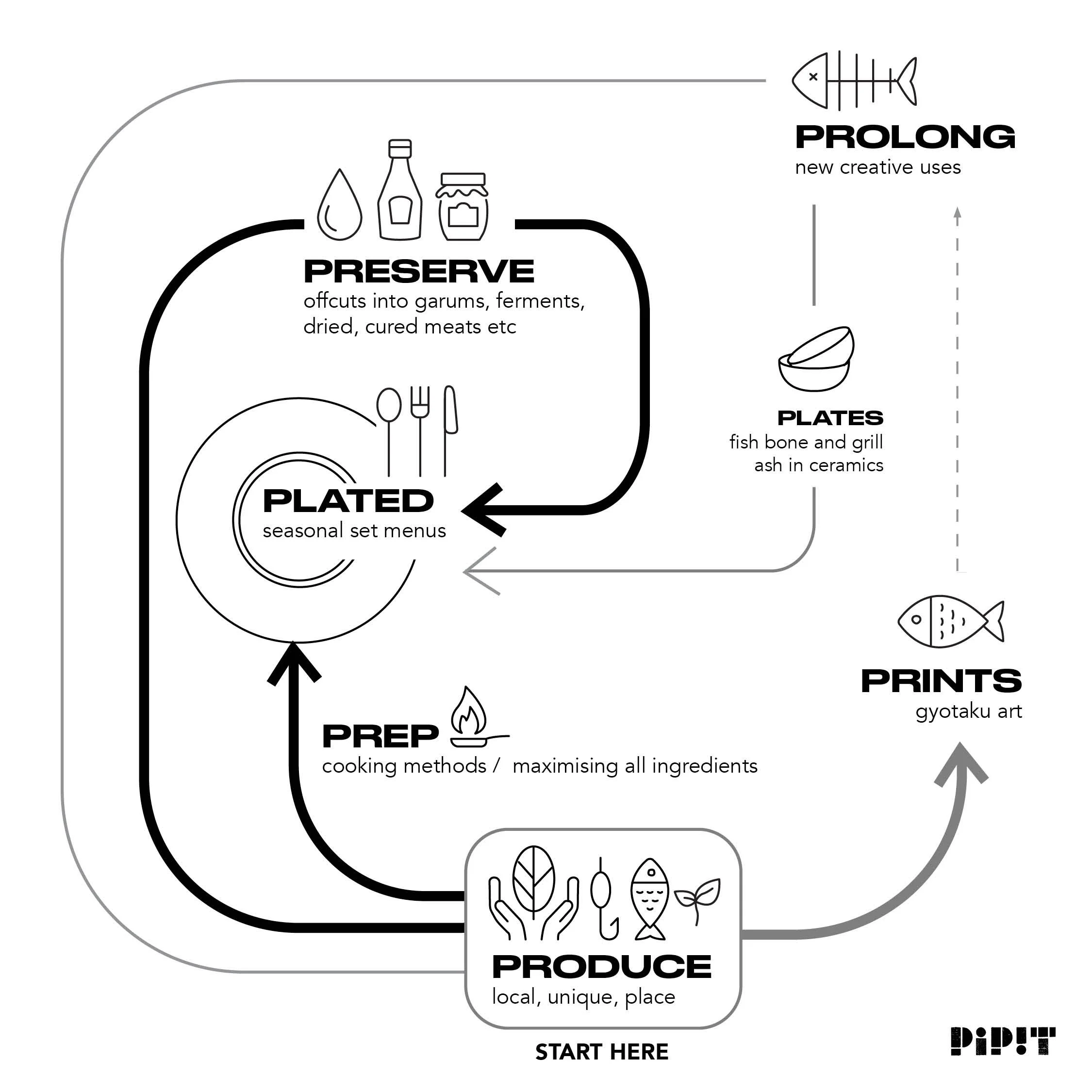
Use Everything! PipitPPP Framework
We look at various opportunities to maximise whole ingredients in a wider system
Produce (sourcing)
Plated (primary cuts, secondary cuts)
Preserves (leftovers into ferments, preserves )
Prints (art)
Prolong (plates, ceramics)
SEASONAL MENUS
We showcase seasons by often blending fresh in season as well preserves from past years. See Three Vintages of Peas recipe > HERE
Dishes will often show multiple methods to maximise a single ingredient. See Oysters recipe > HERE

Examples by ingredient type

RECIPES - 8 x core preserve recipes are shared in the Pipit Book. Info > HERE
BREAD
Leftover bread made into miso, and fermented into “soy sauce” type dressings. Recipe Info > HERE
Bread scraps are made into a porridge to go batch into new bread. Recipe Info > HERE
MEAT
Duck and fish offcuts are cured into charcuterie and hams. Recipe info > HERE
Online duck salumi class and Recipe info > HERE
SEAFOOD
Seafood offcuts are fermented into garums, Recipe info > HERE
Fish cuts (belly, tail etc) made in to hams. Recipe info > HERE
Leftover offcuts and head meat used in terrines. Recipe info > HERE
Whole animals are honoured and fish are further expressed in art prints. Info > HERE
SEAFOOD BONES
Fish bone waste into ceramics in collaboration with Grit Ceramic. Info > HERE. This is small scale but we think there is potential to scale the waste in wider seafood wholesale supply chains
Grouper bone is roasted and made into a flour (for biscuit canape). Recipe info > HERE
Bones and frames are smoked/dried and used in stocks, sauces etc
VEG & FRUITS
We use all parts as much as possible from stem, flowers, leaves, seeds, core etc. Example romanesco dish > HERE
Pickling helps keep vegetables for longer. Recipe in Pipit Book > HERE
“Tasty Waste Paste” ferments much of our vegetable trim into our signature dipping sauce/ pantry staple. Recipe info > HERE
Surplus preserved into seasonings and vinegars. Example Shiso Vinegar with leftover herbs. Recipe info > HERE
Surplus fruit scraps used in infused alcohol. Example Guava Bitter - Info > HERE
We still have green waste and donate weekly (eg 10-15L) to Pottsville Community Garden’s compost
Fruits are preserved in juices, jellies, and powders. Example petite fours > HERE
DAIRY
Caramelised whey in cheese making process. Recipe info > HERE
DRINKS
Wine leftovers converted to fortified digestifs, vinegars or used as cooking alcohol
Coravin preservation systems used to minimises wine wastage
Using supply chain & community waste
SUPPLY CHAIN
We seek out symbiotic relationships to use waste from our suppliers in other food processes.
Examples:
Spent grain from beer production (used in dessert) - Stone & Wood Brewery. Recipe info > HERE
Spent botanics from gin distilling (used in dessert) - Husk Distillery
Waste bay lobster shells (used in stock) - Australia Bay Lobster
Fruit waste from farm pruning practices. Example young green mangos from Picone Farm. Pickle Recipe Info > HERE
Fruit waste from coffee farm for ferments = Zentveld Coffee
We hope to further expand using the seafood waste from wholesale suppliers (for garums etc)
COMMUNITY TREES PROGRAM
We connect with local residents, farms, schools who have surplus or small batch things (eg guava, lemon aspen, curry leaf etc). People will often reach out with things and ask if we can use it
Using surplus via “Community Trees” is both an environmental and social response. Example with Pottsville Preschool > HERE
Apps like Uforage helps communities share and identify community surplus. UForga is local/ Tweed based for us but applies nationwide
FORAGING / NATIVES
Maximisiing native and edible plants found in backyards, public spaces and streets. Often these are planted for decorative reasons and not widely understood as edible (lily pily, seaweed, wattle flowers, native tamarind, beach greens). Foraging maximises food that would be otherwise unused and helps our menus share unique local flavours
READ: Karakalla At Home (Mindy Woods) is as a great native ingredients resource for Bundjalung country
POLICY GAPS: Seaweed (washed up) require NSW commercial licences to forage and it’s policy on size and areas seems shortsighted for culinary uses.
PROLONG: Creative uses and deeper conversations
We purposely extend the conversations about produce as a key point of difference. Creative expressions of this include
Fish bone waste reused in ceramics with Grit Ceramics
Fish leather learning > example HERE
Gyotaku Seafood artwork > more info HERE
Dining events with environmental focus. Example, “Sensational Seaweed” advocacy >HERE
Social media. Example, sea urchins as one of highest shared posts > HERE
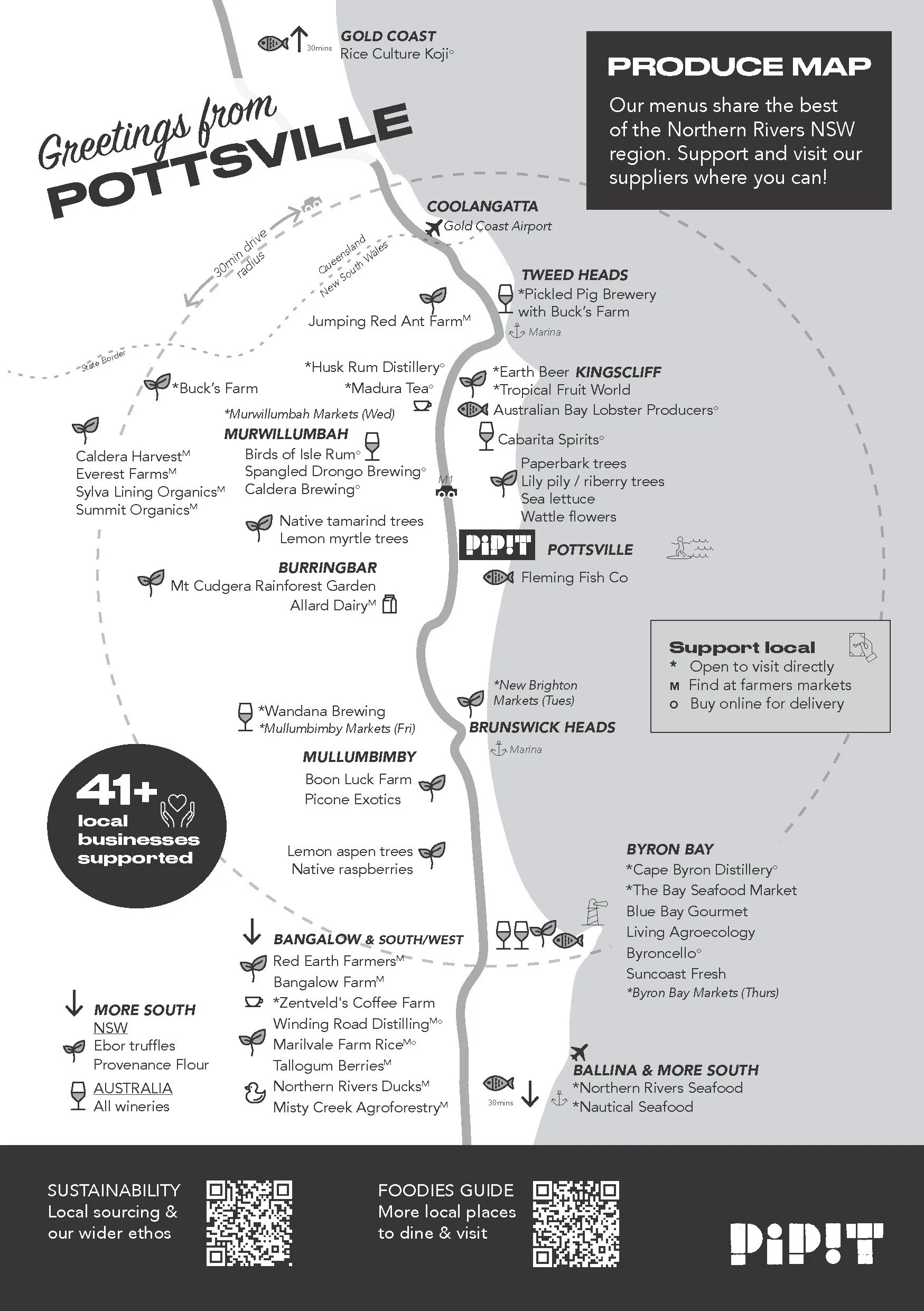
Produce Map. Every guest gets one when dining > more info HERE
ii. MATERIAL & BUILDING SYSTEMS
Examples by type
Bin collections and cleaning services is $10K of our annual business cost so minimising waste is both economic and environmental
MINIMISING PACKAGING
We ask all suppliers to ship in reusable and returnable containers to reduce polystyrene & cardboard boxes as much as possible
We reuse glass bottles from alcohol for storage
We don’t use wine in kegs or bags, but note them as really interesting to minimise waste and maintain quality (reduce oxidisation)
PLASTICS
No cling film used since opening
Invested in more sturdy plastic containers that can be washed and re-used more (ie can last 2 years)
We don’t use vacuum bags and use different methods if we use waterbath (eg coating in bees wax for low temp or packing in jars or containers for higher temps)
Use biodegradable or reusable piping bags
Replaced some chopping boards for wood fibres boards (Seed & Sprout eco product)
CLEANING CHEMICALS
Where possible we switched to organic and lower chemical products
We have not resolved some proprietary options (eg Winterhalter detergents)
OFFICE/ PAPER
Reusable bags for staff tips and banking to reduce plastic/envelopes. See more > HERE (idea from Agrarian Kitchen)
When buying pens, we use brands with recycled plastics
We still have paper waste from printing frequently changing menus. We create decorative crafts with waste menus > Example
We note the move towards QR/ paperless menus in other venues
Reduced packet tissues to guests by replacing to tissue box cover
BAR & GLASS
Filtered water and sparkling water taps. We don’t support bottled water
Recycling as per normal Council bin services
Cans and wine bottles collected as ‘Earn & Return’ via a local charity partner
We have not resolved broken/chipped glassware that can’t be recycled by Councils. Silo UK book notes crushing and reusing their glass
CHARCOAL/ HEAT WASTE
Wood fired cooking is based on using all different heat to maximise the energy. This includes grilling, smoking, drying.
Maximise all heat to reduce charcoal waste. Example of low heat smoking > HERE
More on passive cooking and heat used in wood-fired cooking > HERE
We don’t use gas. Wood-fire was a flavour/ cooking choice but the 2022 Melbourne Food and Wine Forum (*see links below) says one of the best ways to lower carbon footprints is to not use gas in cooking. We note ACT’s policy changes (2023) to phase out gas in new buildings as a key change we will likely see more of.
ELECTRICITY/ ENERGY
Retrofitted glass louvres and screens to passively vent equipment heat overnight and in summer
Installed blinds and window tinting to reduce sun and indirect heating in summer
We have been unsuccessful in adding solar power due to cost and approvals, but note our whole building roof (800m2) would be needed to bring power bills down close to nil
Air-conditioning is one of our highest electricity challenges. Flies, humidity, wind, and open kitchens means our external windows are closed in summer to improve guest experiences
We have LED lights and do not turn on some lights outside of service times
WATER
Ice and water in prep (cleaning vegetables) is collected and used on our pot plants
Removed our ice machine and make ice by trays (READ: about waste in ice machines in Silo UK’s book).
We have not resolved commercial dishwashers as high water users
We do not use “e-water” solutions but note their positive use by other venues
In fine dining, our highest use is guest drinking water, washing veg prep, dishwashing more plates in service.
READ: Sydney Water for benchmarking resources
PART 2) ECONOMIC SUSTAINABILITY
Cost models and supporting future industry
PURCHASING POWER / SOURCING POLICY
Question: What do you think the role of the hospitality industry is, when it comes to the sustainability movement? For example, many people believe the hospitality industry is uniquely placed to shape and influence food trends more generally.
Restaurants can hopefully influence and shape food trends but our best and immediate influence is "purchasing power". As a small business, Pipit tracks and spend approx $60K annually on sustainable seafood (as ambassadors of Good Fish Project). That is a tiny food cost compared to other bigger businesses but let's consider that $60K is a salary in someone else's business. Which people do we want to our dollars on? Local ones, sustainable ones, local producers we have built a connection with. Collectively the hospitality industry would be millions of dollars of purchasing influence!
100% of our food spend is with local businesses and wholesalers ($124 000 annual)
100% of our drinks spend is Australian (we don't support imported wines) ($55 000 annual)
We buy from 40+ local business (within 30-45min drive) - and this is acknowledged in the Pipit Produce Map that every diner gets to also further support direct sales to suppliers
We source our proteins sustainably considering the AMCS Seafood Guide, free-range farms, pest eradication of game meats (see Part 1)
We buy from wholesalers, direct farms, Byron Bay Farmers market weekly to maintain direct connection to farmers
We visit farms for staff training and to see best practice
BUSINESS MODELS
COVID and cost of living pressures has shown the economic vulnerabilities of our business, region and industry. In 2025, 1 in 10 hospitality business closed and the industry is at the highest risk of default.
We support the wider discussion about dining, pricing and wage reform for industry change.
READ: Why Restaurants Are Fucked (2020) and $50 mains are here to stay (2022)
LISTEN - DIrty Linen Podcast (2023) Pricing Series. PBK Noodles & Nomad and economics Cornersmith (2024)
SEE - The trend of large hospo groups VS small restaurants as noted with Gourmet Traveller Awards (2024+) adding this criteria shows an underlying imbalance and risk model to small chef-owner models.
READ: Looking at start up/ financial models: A+ Insight on Incubators, 2025
We comply with Fair Work but also note hospitality wages are still lower than other sectors. Service workers saving for home-ownership or to own venues is a economic/social concern. READ: Wage surcharging by Pasture (Auckland, 2021)
FUTURE INDUSTRY PLANNING.
We focus on advocating for:
CHEF-OWNERS
We are a chef-owner business model and we aim to train, empower and co-invest towards business ownership for our team.
We use pop-ups for fostering business ideas and young chefs. See Chefs Collab info > HERE
YOUNG PEOPLE
Since 2021, we offer 10% dining discounts for chef apprentices and trainees to help regional training. See> HERE
We do work experience and class excursions with high school hospitality students
We hire apprentices, and junior roles.
FRONT OF HOUSE
Most industry initiatives/media/funding focus on chefs. We support the wider recognition of front of house as a profession.
We support FOH awards. Pipit has been recognised in Eat Easy Awards & Good Food Service Award
Collaborative wIne training with local venues. See Hospo Wine Group> HERE
WOMEN
Promote women in leadership in hiring and events. See Girl Gang mentors booklet info > HERESupporting return -to-work mums. Subsidised home care is available to hospo night shift workers. See >HERE (NSW)
Our team is over 50% women
ADVOCATING REGIONAL DINING & VISITOR ECONOMY
Dining supports flow-on economic and social networks READ: “Fine dining reshaping local communities” Landline article (2022)
We actively collaborate with other Northern Rivers venues to support industry training and regional networks. (eg Hospo Wine Group and Chefs Collabs with over 30 restaurants)
We support Tweed Tourism famils and promote the region as a dining destination. “the Northern Rivers officially the most foodie region in NSW” (2022) READ: Regional Restaurants Good Food Guide
Support region-to-region famils for business mentoring and industry development (eg 2023 Riverina -Murray hospo owners visited Tweed, and Wine Tasmania tour). We hope to do more outbound programs to learn from others
We represent Tweed in NSW Tourism awards to elevate dining as valuable part of agritourism.
BANKING/ CLEAN MONEY
“Clean money” is an interesting area that small businesses can look at.
Example - Bank Australia, Summerland Credit Union as BCorp banks and ethical super funds etc.
OFFSETS
We do not currently pay for offset (mostly due to costs and audit measures) but note it as valid area
CARBON OFFSET. Carbon neutral targets and measures are possible with environmental consultants who do this work
SEAFOOD OFFSET. We see innovation in Seafood Positive/ One Fish Two Fish. $1 per kg of seafood is paid to be invested into marine habitat projects. It would cost us approx $1K / year as a small venue
PART 3) SOCIAL SUSTAINABILITY
Team and community
ELEVATING TEAMS / INCLUSIVE WORKPLACES
We have zero tolerance on drug use, harassment and bullying
We have employment contracts, Staff Handbook, induction and training plans
We focus on positive culture, training pathways and well-being in our team, with initiatives like:
Staffie Sunday - monthly team sharing, training and input into business development. Includes team member sharing about any “non-hospo” topic they care about. CASE STUDY: Attica Staff Talks
Team tours to connect and learn with local producers (quarterly)
Supporting personal projects, pop-ups and sabbaticals
Training support and inter-generational industry planning (see Part 2)
We meet Fair Work award requirements
We share tips equally to all roles
We focus learning pathways on Chef-Owners, Front of House, Women, Young People (see PART 2- Future Industry Planning)
READ: Valuing Teams (MSIX). We elevate our team further in:
Open plan design where all roles are seen - therefore hopefully more understood> respected > valued (by team and guests)
Team advocacy on social media - sharing about people /roles, especially junior roles
Team advocacy on website and print menus - all team names are listed for recognition and visibility
Elevating FOH and Young Chefs (see Part 2)
COMMUNITY
Other ways we support and connect with our wider community
Over $2K in voucher donations for various charity, local schools and fundraisers
Parents Date Night with local daycares. 2023 example > HERE
Fundraising. 2022 Flood Raffle > HERE
Business Giveaways. 2021 Small business owners > HERE
MENTAL HEALTH - Small business owners
We support and advocate for the wider respect of hospitality professionals
Negative guest behaviours impacts team well-being and ultimately impacts economic sustainability to retain staff and owners
The responsibility of guests. READ: Post by VanBones (2023)
Coping with online reviews. READ: “Say Don’t Slay” hospo campaign (2021)
We’ve used New Access for Small Business (free mental health coaching with Beyond Blue)
2024 - part of the Pottsville Business Group supporting local owners
POLICY ADVOCACY
Pop-up events can explore wider land management and policy issues.
2021 - Agroecology Systems > HERE2024 - Seaweed Menu / Marine science > HERE
2025 - Marine Cup / Marine science“Restaurants and Place-Making” (policy advocacy) > HERE. Restaurants can engage, inform, and advocate many policy conversations such as:
Mixed use buildings and street activation policy
Streetscape policy (edible plants, community gardens)
Transport planning (*most of our diners have to drive)
Rural lands and urban sprawl (leasing threats to our farm suppliers)
Housing affordability (housing in jobs offers and lower wage workers)
Green building design (there is no clear guide for restaurant fit outs)
PART 4) APPENDIX
PIPIT MEDIA
TALKS
Full Circle Restaurants - Talk at Kita Food Festival Malaysia 2024
Designing Valuing in Restaurants - Talk at Marketing Science Ideas Exchange 2024
Design Thinking & Restaurants - Talk at Design Conference 2024
AWARDS
Tweed Council Sustainability Awards 2023 and 2025
NSW Quality Tourism Program: Sustainability Tourism Accredited 2024
Destination North Coast Tourism Awards - Business Leadership Award 2024
Sustainability and Innovation Finalist in 2019 Gourmet Traveller Restaurant Awards
MEDIA
”Watch your Waste Line” 2021 - The Australian
”How to Embrace Sustainability” 2022 - Concrete Playground
Well Traveller with Tweed Tourism Company
Australia’s Most Sustainable Restaurants - 2023 - Urban List
HOSPO RESOURCES: Case studies and reading
VENUE CASE STUDIES
Other Australian venues to look to:
Bar Midland VIC- sourcing only within Victoria
RE: Bar NSW - “never wasted” menus, circular economy
Future Food Systems VIC - demonstration project
READING / RESEARCH
BOOK: Silo: The Zero Waste Blueprint by Douglas McMaster (2019) . UK-based info, but very good in showing clear action by ingredient and kitchen systems.
BOOK/ GUIDE: No Mise En Plastic (UK) -practical guide for chefs on kitchen systems
LISTEN: Melbourne Food and Wine Industry Forum (2022) - Why Design Matters. Jeremy McLeod/ Breath Architects talks about carbon footprints and design fitout
RESEARCH: Cameron Matthews (2016) - Churchill Fellowship tour & report - Sustainability in high end restaurants.
MENU 2034: Future of Food : Synthesis (Singapore)
POLICY GUIDES
LOCAL POLICY: 2009 Sustainability Guide for Hospitality (by NSW Business Chamber). It’s old, but we archive it here for good handy basics.
INTERNATIONAL POLICY (UK): Sustainable Restaurant Association and Food Made Good Standards (accreditation)